

US Customs Form 3299: Complete Guide for Household Goods
Declaration for Free Entry of Unaccompanied Articles
 BAR Member
Advance Payment
Guarantee
 IAM Premier
Verified Global
Networks
If you are moving household goods to the USA, CBP Form 3299 is one of the main customs documents you may need to complete. Officially called the Declaration for Free Entry of Unaccompanied Articles, it is used to declare personal belongings and household effects that are being shipped separately from you. This guide explains who needs Form 3299, what information is required, which goods may qualify for duty-free entry and how to complete each part of the form correctly.
Quick links:
- What Is Form 3299
- When You Need It
- Duty-Free Goods
- Household vs Personal Effects
- Arrival Before Clearance
- Required Documents
- Completing the Form
- Common Mistakes
- Clearing on Your Behalf
- Shipping Separately
- Import Time Limit
- Customs Inspections
- Form 3299 Checklist
- How We Help
- Download the Form
- Resources
- Customer Reviews
What is US Customs Form 3299?
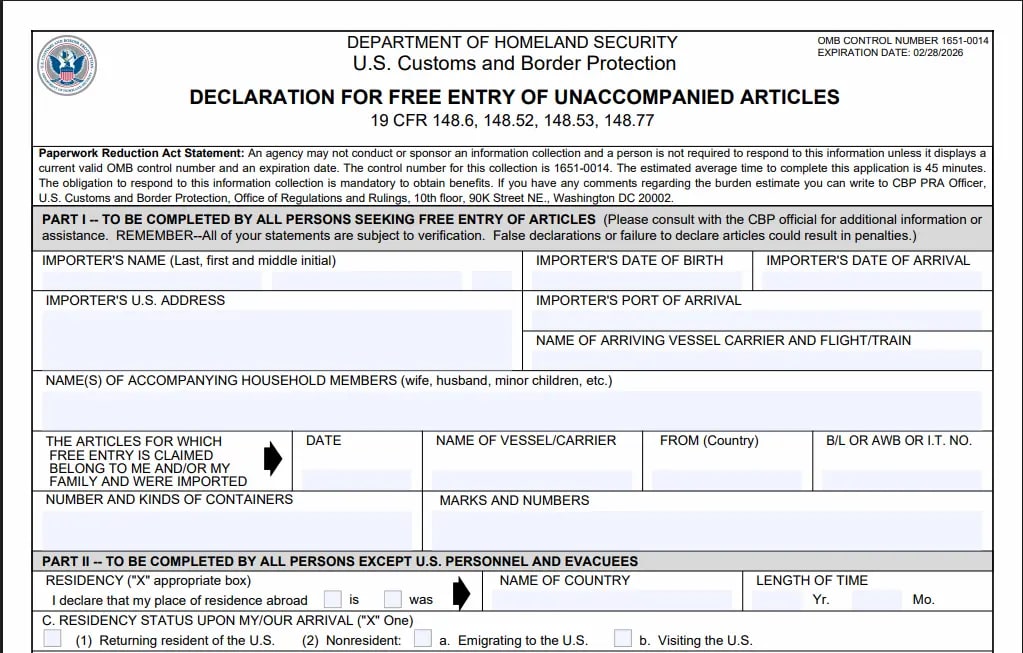
CBP Form 3299 – Declaration for Free Entry of Unaccompanied Articles – is the US customs form normally used when your household goods or personal effects are shipped separately from you to the United States.
For example, if you fly to the USA and your furniture, clothing and other belongings follow later by sea freight, Form 3299 is used to declare those goods to US Customs and Border Protection (CBP) and, where the conditions are met, claim duty-free entry.
The form is used by both US residents returning to America and people moving to the United States from another country.
It records:
- who is importing the goods;
- when and how you entered the United States;
- your residency or immigration status;
- where the goods have come from;
- how long your household effects have been used abroad;
- shipment and carrier information; and
- any goods that need to be specifically declared.
If you are moving household goods from the UK to the USA, Form 3299 will normally form part of your customs clearance paperwork.
Important: Form 3299 does not automatically make everything in a shipment duty-free. Eligibility depends on what the goods are, how they have been used and your individual circumstances.
When Do I Need Form 3299?
You will normally need Form 3299 when personal or household belongings are entering the United States separately from you.
This can include:
- a British citizen emigrating to the USA;
- a US citizen returning home after living in the UK;
- a US permanent resident returning to America;
- someone moving to the USA on an eligible work, family or other visa;
- students or other temporary residents importing personal belongings; and
- certain US government or military personnel returning from an overseas assignment.
It is called a declaration for “unaccompanied articles” because the belongings are not physically travelling through US customs with you as passenger baggage.
What Household Goods Can Normally Enter the USA Duty-Free?
Used household effects may normally qualify for duty-free entry when they have been used abroad for at least one year and are being imported for your own household use rather than for somebody else or for resale.
Typical household effects include:
- furniture;
- beds and mattresses;
- tables and chairs;
- sofas;
- carpets and rugs;
- crockery and tableware;
- kitchen equipment;
- books;
- pictures and artwork;
- linens and bedding; and
- normal household furnishings.
The important test is generally the use of the goods abroad, rather than simply when they were purchased.
Goods used abroad for less than one year may still be imported, but they may be subject to duty.
Household Effects vs Personal Effects
US Customs distinguishes between household effects and personal effects.
Household effects are normal furnishings and possessions used within the home.
Personal effects are belongings associated more directly with an individual, such as:
- clothing;
- jewellery;
- cameras and photographic equipment; and
- other personal possessions.
The distinction matters because different customs provisions may apply depending on your residency status and the type of goods being imported.
Do I Have to Be in the USA Before My Goods Can Clear Customs?
Form 3299 asks for details of your arrival into the United States, including your date of arrival, port of arrival and how you entered the country.
For most international removals this means the importer will normally have entered the United States before the household shipment is cleared.
The date requested on the form is not simply the date your container reaches America. CBP asks for the importer's last arrival into the United States from the country where the goods were used.
Your removal company or customs agent can advise you about the timing of your shipment and the documentation required before clearance takes place.
What Documents Are Normally Required With Form 3299?
Form 3299 is only one part of the customs clearance documentation for an international household move.
Depending on your circumstances, you may also be asked for:
- a copy of your passport;
- evidence of your legal status in the United States, such as a US passport, visa, permanent resident documentation or relevant immigration documents;
- a detailed inventory or packing list;
- Bill of Lading or other shipment reference;
- customs authority or Power of Attorney where an agent is clearing the goods on your behalf; and
- additional declarations or permits for controlled or restricted goods.
CBP requires sufficient information to identify the goods being imported. Simply describing an entire shipment as “household effects” is not normally sufficient – a proper inventory should be available.
How to Complete US Customs Form 3299
The form looks complicated at first, but it becomes much easier once you understand what each section is asking for.
Part I – Importer and Shipment Information
Part I identifies you and your shipment.
You will be asked for information including:
Importer's Name
Enter the full name of the person importing the household goods. This should normally correspond with your passport and the person named on the shipping and customs documentation.
Date of Birth
Enter the importer's date of birth.
Date of Arrival in the USA
Enter your relevant arrival date into the United States. CBP describes this as the importer's last arrival into the United States from the country where the household goods were used.
US Address
Provide your address in the United States. If you do not yet have a permanent US address, another address through which you can reliably be contacted may be appropriate, such as an employer's or relative's address.
Port of Arrival
This means the place you entered the United States. It is not necessarily the same port at which your household goods arrive.
Examples of ports of arrival include:
- New York JFK;
- Miami;
- Los Angeles;
- Atlanta; or
- another US airport, seaport or land border crossing.
Arriving Carrier
Enter the airline, vessel, train or other means by which you entered the USA. For an air arrival, for example, this may include the airline and flight number.
Accompanying Household Members
List relevant immediate family members who travelled with you, such as your spouse and children.
Part I – Shipment Details
Part I also contains information about the shipment itself. This may include:
- arrival date of the shipment;
- vessel or carrier;
- country from which the goods were shipped;
- Bill of Lading, Air Waybill or other transport reference;
- number and type of packages or containers; and
- identifying marks or shipment numbers.
Some of this information may not be available when you first start completing the form.
1st Move International can provide the relevant shipping information relating to your shipment where required.
Part II – Your Residency and Eligibility
Part II helps CBP establish your status and why you are claiming free entry for the goods.
You may be asked to identify whether you are:
- a returning US resident;
- emigrating to the United States;
- a temporary visitor or non-immigrant; or
- another qualifying category.
You will also be asked about:
- the country in which you were resident;
- how long the household goods were used abroad; and
- your residency status on entering the United States.
The form then contains statements relating to the particular goods for which free entry is being claimed. More than one category can apply to a shipment.
Part III – US Government Personnel and Evacuees
Part III is specifically for certain US government personnel and evacuees. For most private individuals moving from the UK to the USA, this section will not apply.
Do not complete sections that are not relevant to your circumstances unless instructed to do so by your customs agent.
Part IV – Goods That Must Be Declared
Part IV is one of the most important parts of Form 3299. It asks whether your shipment contains particular categories of goods or goods which may require duty, additional documentation or further customs attention.
The form distinguishes between goods depending on matters such as:
- whether they have been used abroad for less or more than one year;
- whether personal effects were acquired abroad;
- whether foreign-made goods were previously in the United States; and
- whether goods were taken abroad for repair or alteration.
If a category applies, it should be declared accurately.
Goods Used for Less Than One Year
Household effects acquired abroad and used for less than one year should be declared. These goods may be subject to US customs duty.
Goods Used for More Than One Year
Household effects acquired abroad and used for at least one year may generally qualify for duty-free entry, subject to the relevant customs conditions.
Restricted or Controlled Goods
Some items require additional declarations, licences or approval and some cannot be imported at all. Particular care should be taken with goods such as:
- food;
- alcohol;
- firearms and ammunition;
- plants and plant products;
- animal products;
- medicines;
- antiques or cultural property; and
- certain wildlife products.
See our US Customs, Prohibited & Restricted Items Guide before packing anything you are unsure about.
Part IV – List of Articles
Where the form requires individual goods to be listed, provide enough information for Customs to understand what is being declared.
Depending on the item, CBP may require information such as:
- description;
- quantity;
- material;
- country of manufacture;
- value; or
- cost of repairs or alterations.
Your detailed removal inventory or packing list will also form an important part of the customs declaration.
Part V – Carrier's Certificate and Release Order
Part V relates to the carrier transporting the goods. Where a moving or freight company has been employed, this section provides the carrier information and authorises release of the shipment to the consignee.
This section is therefore normally dealt with as part of the shipping and customs-clearance process rather than being completed independently by the customer.
Part VI – Certification
Part VI confirms that the declaration is correct and complete.
The declaration may be completed by:
- the importer; or
- an authorised agent acting on the importer's behalf.
Where an authorised agent signs the declaration, appropriate authority or Power of Attorney may also be required.
Make sure the declaration has been properly signed and dated where required before it is submitted for customs clearance.
Part VII – CBP Use Only
Do not complete Part VII.
This section is reserved for US Customs and Border Protection and records the customs officer's inspection and release of the goods.
Common Form 3299 Mistakes to Avoid
Most Form 3299 problems are relatively simple paperwork errors. Before submitting the form, check for:
1. Using the Wrong Arrival Date
The arrival information relates to the importer entering the United States, not simply the arrival of the container.
2. Confusing Your Arrival Port With the Shipment Port
If you flew into JFK but your container arrived in New York/New Jersey or another US port, these are two different pieces of information.
3. Saying Everything Was “Household Effects”
CBP may require a detailed inventory of the goods being imported. Your packing list should properly describe what is contained in the shipment.
4. Not Declaring Newer Goods
Do not assume everything in a household move automatically qualifies for duty-free entry. Goods used abroad for less than one year should be declared where required.
5. Failing to Declare Restricted Goods
Food, alcohol and other controlled goods can have separate import requirements. If in doubt, tell us before the goods are packed.
6. Missing Signatures or Dates
Check that every section requiring your signature or date has been completed.
7. Completing Sections That Don't Apply
Form 3299 covers several different types of importer. Not every box or section needs to be completed by every person.
Can Someone Clear My Household Goods on My Behalf?
Yes.
An authorised customs agent can normally act on your behalf during the clearance process.
Another authorised person may also be able to clear household goods in appropriate circumstances, although written authority or Power of Attorney and supporting documentation may be required.
This is why your US customs paperwork will normally include authority for the destination customs agent to deal with CBP on your behalf.
Do My Household Goods Have to Arrive at the Same Time as Me?
No.
Form 3299 specifically exists for unaccompanied articles, so your household belongings do not have to travel to America with you. They can arrive separately by sea or air.
Qualifying household and personal effects do not necessarily have to be imported in one single shipment.
How Long After Moving to the USA Can I Import My Household Goods?
CBP advises that household and personal effects should generally be imported within 10 years of your last arrival in the United States from the country where the goods were used if duty-free treatment is being claimed.
After 10 years, additional justification may be required.
For a normal international relocation this is unlikely to be an issue, as most customers ship their household belongings around the time of their move.
Can Furniture and Household Goods Be Inspected by US Customs?
Yes.
All goods entering the United States remain subject to inspection by US Customs and Border Protection.
Completing Form 3299 does not prevent Customs from:
- examining the shipment;
- requesting additional information;
- asking for proof of eligibility;
- referring controlled goods to another government agency; or
- assessing duty where applicable.
Accurate paperwork and a clear inventory make the clearance process considerably easier.
Form 3299 Checklist
Before returning your customs documents, check that you have:
- completed your full importer details;
- supplied the correct US arrival information;
- provided a US contact address;
- stated your residency or immigration status correctly;
- confirmed how long your household goods have been used abroad;
- declared any goods used for less than one year;
- declared any restricted or controlled items;
- provided a detailed inventory;
- supplied any requested passport or immigration documentation; and
- signed and dated the declaration where required.
How 1st Move International Helps With US Customs Clearance
If you are moving with 1st Move International, you do not have to work through the US customs process entirely on your own.
We provide the relevant shipment information needed for your customs documentation and work with our destination partners to arrange customs clearance and delivery in the United States.
Before your shipment departs we will advise you which documents are required and highlight any information that needs to be completed by you.
However, the information you provide on Form 3299 remains your declaration to US Customs, so it is important that it is complete and accurate.
Download the Official CBP Form 3299
Always use the current version of the form supplied by U.S. Customs and Border Protection.
Download or view CBP Form 3299 – Declaration for Free Entry of Unaccompanied Articles
Important
This guide is intended to explain Form 3299 in straightforward terms for customers moving household goods to the United States. US customs requirements can vary according to your residency status, the contents of your shipment and your individual circumstances. Final decisions on admissibility and duty are made by US Customs and Border Protection.

135,000+ Happy Customers
9,240,000+ Cubic Feet Shipped
25+ Years' Experience
Resources
Useful Resources & Services for the USA
International Removals UK to USA
Discover our door-to-door removals services from the United Kingdom to the USA with faster weekly shipping.
Shipping Furniture & Personal Effects to the USA
Everything you need to know about shipping furniture & personal effects from the UK to the USA.
Container Shipping Costs UK to USA
Get the latest information on UK to USA container shipping costs and American container ports.
U.S. Customs, Prohibited & Restricted Items
Check out our detailed list of prohibited and restricted items when shipping to America with details on how to declare and import duties.
USA Container Shipping Schedules
We post up-to-date sailing schedule information and as part of our weekly shipping promise we'll tell you in advance what ship we can get your personal effects on.
USA Moving Guides
Whether you're looking for basic moving tips, city info, or full visa and immigration guides we've got you covered.
Car Shipping USA
We ship cars too. Get more information on our car shipping service.
Testimonials
